

What you need:
- a squash court
- two squash rackets
- two people
- none-marking shoes
- a squash ball
to begin:
The Serve:
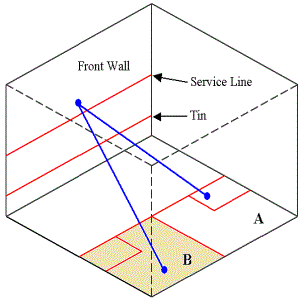
The diagram below illustrates the layout of the squash court. Each opponent stands in one half of the court (A or B). The game starts with the serve. Here the serving player must keep one foot in the service box within his half of the court. He must then hit the ball above the red line that is about half way up (the service line), and, if allowed to drop before his opponent returns it, lands in his opponents back quarter of the court.
The Return:
The player on the receiving side of the court must return the ball anywhere to the front wall above the lowest red line ('the Tin'). The ball does not have to bounce before being returned, but can't bounce more than once. On the return, the ball can hit any of the walls, but must hit the front wall at least once.
Continuing play:
The players keep alternating shots that can hit any wall, but hit the front wall at least once. The ralley ends if the ball:
- is hit above any of the high red lines ('out lines')
- is allowed to bounce more than once before return
- is hit on or below the Tin on the Front wall
- does not hit the front wall when returned
Scoring PARS:
A match is the best of 3 or 5 games at the option of the organisers of the competition.
Each game is played to 11 points. The player who scores 11 points first wins the game except that if the score reaches 10-all, the game continues until one player leads by two points.
Either player may score points (PAR - Point A Rally). The server, on winning a rally, scores a point and retains the service; the receiver, on winning a rally, scores a point and becomes the server.
Scoring Traditional to 9:
A match is the best of 3 or 5 games at the option of the organisers of the competition.
The player who scores 9 points first wins the game, except that on the score reaching 8-all for the first time, the receiver chooses, before the next service, to continue that game either to 9 (known as "Set 1") or to 10 (known as "Set 2" ). In the latter case the player who scores 2 more points wins the game. The receiver must clearly indicate this choice to the Marker, Referee and the opponent.
Only the server scores points. The server, on winning a rally, scores a point; the receiver, on winning a rally, becomes the server without a change of score.
If the server wins a rally, he/she continues to serve alternating serving boxes after each rally.